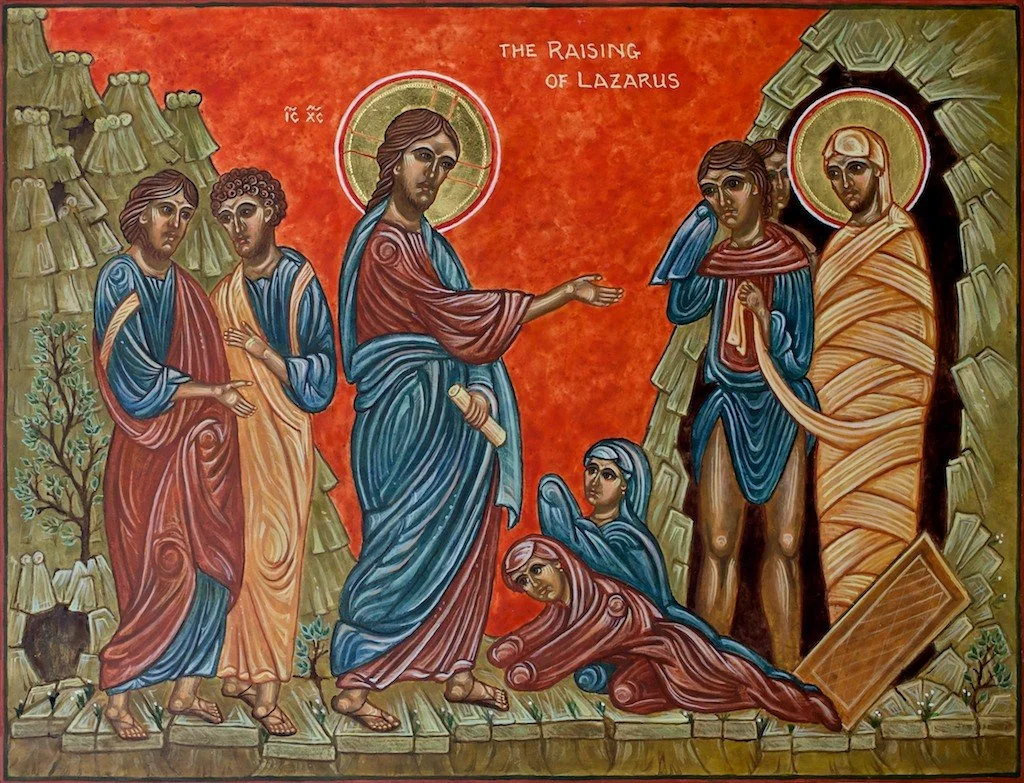
I’m unsure why her statement never struck me before as it did in preparing for Easter. I used the final of the seven “I Am” statements of Jesus in John’s gospel. John especially wanted us to understand the nature of Christ. At Lazarus’ graveside, Jesus said, “I am the resurrection and the life. The one who lives and believes in me will never die.” This seems a perplexing word to speak in a graveyard with a corpse nearby. But the mourners in Bethany were about to witness one of Jesus’ most well-known miracles when he raised Lazarus.
Before he spoke these words, Martha met Jesus with a word of disappointment: “Lord, if you had been here, my brother would not have died.” I imagine Mary’s thoughts were a bit different in her heart. She must’ve been thinking, “Lord, where have you been? We summoned you nearly a week ago!”
I’ve superintended nearly 400 funerals in my life. I don’t know if this is the norm for other pastors or not, but I’ve seen much of death. Sometimes death is welcomed when people are sick with no hope of healing and their pain is excruciating. Sometimes medications make them sleep, rob them of ability to communicate and remove all family interaction.
But most often the death angel is unwelcomed. Perhaps in our grief, we echo what Martha must have felt: “Lord, where have you been?
I conducted a funeral for a church member who was robbed and murdered. This was a truly awful event. Twice I’ve conducted funerals for children. One was an infant two or three days old. The other was little Lisa, aged 8, who was struck by a car and killed at a family gathering one Sunday afternoon. I was a seminary student in Kentucky and served a church across the Ohio river in Indiana. I rode with the family to the hospital but knew Lisa, in the car with us, was already dead.
It’s in times of tragedy that our humanity reveals itself in a Martha-like way: “Lord, where have you been? If you’d been here, this would not have happened.”
I really don’t think it’s blasphemy to have these feelings. If the Psalms teach us anything, they teach us the full range of human emotion, including such appeals as, “Lord, wake up and come help me!” (Psalm 44:23). It’s healing to put our thoughts into prayers to God. He’s big enough not to be offended at our brashness.
Though we wrestle with life’s tragedies, scripture assures our Shepherd walks with us through the valley of the shadow of death. And the risen Christ, who traveled this road himself, welcomes us on the other side of death.