I had the privilege of serving the First Baptist Church in Selma for seven years. This is a inner-city church with three others nearby, and I commonly walked downtown for lunch or shopping.
One day I made the first lap of the Selma-to-Montgomery march.
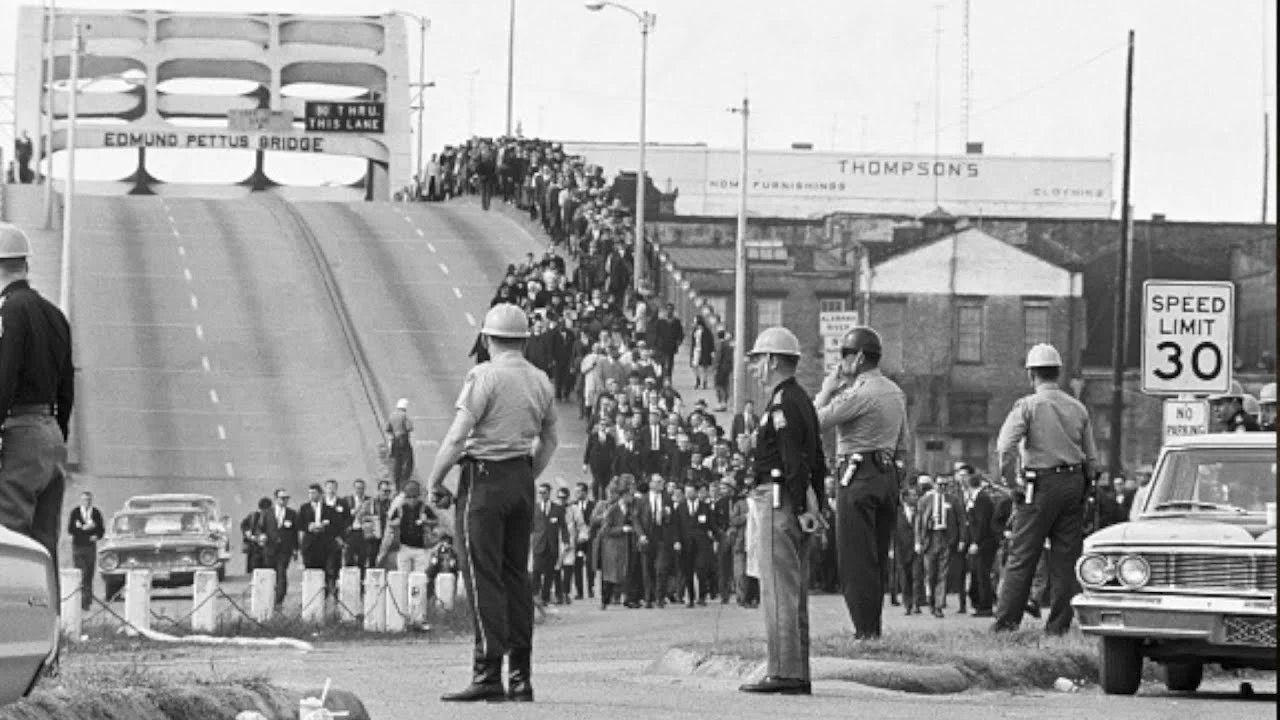
The now-called “Bloody Sunday” event occurred on March 7, 1965. After Jimmie Lee Jackson was killed in nearby Marion in February, civil rights leaders talked about a protest--taking his casket from Marion to “George Wallace’s doorstep” (Alabama governor at the time). Somehow this morphed into the idea instead for a march from Selma to Montgomery.
The original march was ill-timed on a Sunday afternoon. Ladies came dressed in heels from church, and some had their babies, I’m told. Dr. King, who’d been in Selma, was in Atlanta that day. Furthermore, Gov. Wallace gave the order that the march not take place. So, it was a terrible disaster.
With a federal judge’s permission, the actual march began a few weeks later.
One of our church members operated an automobile service center on the Montgomery side of the bridge. He offered “drive to work” service with morning drop-offs. My car was ready one afternoon and I decided since it was a pretty day to make the one-mile journey on foot. Though I’d driven over the Edmund Pettus Bridge scores of times, this was my only time to walk.
I remember at the top of the bridge gazing into the Alabama River below and thinking how high the bridge was at that point. One of the marchers on March 7 recalled that she thought of escaping Alabama State Troopers by leaping into the river. This might have been a tough thing to survive. (I imagine today the river has alligators.)
Two men in Selma told me they’d been on the bridge that day. One man had no business there since he was a racisr “outside agitator,” a phrase Gov. Wallace popularized in his campaigns, but the other man had been in law enforcement. The former officer told about the chaos that day and how he choked on tear gas he was unprepared for. He said his heart was filled with vitriol on Bloody Sunday.
When I knew him he was a gentleman, loving and kind to all.
He finished the story telling me, “God changed my heart.”
Later I was called on to superintend his funeral. I was honored to say some nice things about my friend.
And I cannot cross that bridge, occasionally, and in an automobile, without thinking of his affirmation of God’s grace.
The God we serve offers to take whatever ugliness we have in our hearts and to set us on a better path.