



America is host to many ethnicities, and Christians must set the pace in brotherly love.
I met her at a conference where we were assigned to the same table. She was bubbling with excitement about her church.
“It’s changed my life and my family’s life,” she said. “We can’t wait ‘til Sundays come!”
Her enthusiasm was refreshing to hear. But then she puzzled me when she told me where she lived and where her church was. The church is some 50 miles from her home, and three counties away.
Many of us were schooled differently.
I remember the Church Covenant that was frequently displayed on the walls of churches, right next to the attendance board. The covenant was common to missionary Baptist churches in the day and is traceable to John Newton Brown who included it in his “Baptist Church Manual” in 1853. The last line reads, “We moreover engage that, when we remove from this place, we will as soon as possible unite with some other church where we can carry out the spirit of this covenant and the principles of God’s Word.”
Many modern churches don’t display the covenant, and it’s true some church members, like the lady I met, don’t practice it. The idea is that we should belong to local churches in order to be involved in their ministries in local communities.
My mother-in-law listens to gospel music produced by a Southern preacher and played on his cable channel. I watched one day and heard him read the names of new church members, many of whom were from other states. This is an interesting phenomenon. I assume they worship through cyberspace and mail offerings, but again the question is how do they participate in their church’s ministry in the local community?
I’ve seen similar situations in some of the rural churches in our state who include members on their rolls from other places. These grew up in those churches but decided not to move their memberships—this would be almost like abandoning their culture, I’ve heard it said. Sometimes these far-away folk return for the annual homecoming service, and, of course, everyone is happy to see them. But the basic question remains: how do they participate in their church’s ministry in the local community?
I know we can’t be rigid about how far is too far. I’ve known people who’ve driven across their cities to attend churches on the other side of town. And I’ve heard it said, “It’s not the church nearest; it’s the church dearest.” But the basic premise of church membership remains that not only are we called to support our churches financially, but also to help them make a difference for God in local communities.
As Jesus said, the work begins in our own “Jerusalem” (Acts 1:8).
It used to be said that we had more Baptists than kudzu in Alabama. Now there are a few less since I bade farewell to three on the same day.
A Baptist girl whom I had baptized, along with her mother, had a Roman Catholic wedding a few days ago. She took the faith of her husband. It was a gorgeous worship place and a beautiful wedding. In the realm of “it’s a small world,” Paul and Jan came over to say “hi” after the ceremony. Jan is a friend of the groom’s mother, and I was pleasantly surprised to see them at the event. I performed their wedding in Selma, Ala. many years ago—they reminded me it had been 30 years. This formerly Baptist couple told me they were “recovering Baptists,” now attending a PCA church.
Studies show that not only are people moving to different churches within their own denominations with greater frequency today, but many are moving to and fro among various denominations. They’re moving away from the churches of their childhood, or what Episcopalians call their “cradle church.” The denominational label takes a back seat to children’s programs, youth programs, worship styles, friendships, ministries, location and other factors.
I’m not sure what to make of this other than to recognize it’s a societal change about which we have little control. The fire marshal won’t let us lock them in!
But evangelicals teach that our young people shouldn’t marry outside their faith. This doesn’t mean outside their denomination; it means marrying someone with no faith. As the Apostle Paul wrote, “Be not unequally yoked with unbelievers.” Paul’s counsel was in accord with the Old Testament exhortation to Israel not to marry Canaanites who didn’t share their faith.
Of course one of the great stories in the Old Testament is about Ruth, a Moabite, who accepted Hebrew faith and became the great-grandmother of King David. But idol-worshipping Canaanites were not normally to be in the prospect pool for Hebrew marriages.
I spent 15 years at a Christian college. One day a student told me about her friend, devout in her faith, who was dating a “callow fellow” (as Tom Jones used to sing). I expressed surprise at her choice of dating material.
“Oh, she’s missionary dating,” the student told me.
Apparently, this concept means to date a ruffian with the intention of bringing him to Christ. I’ve always had doubts about the efficacy of this. The movie, “Grease,” demonstrated that the ruffian can bring the good girl low.
As far as marriage is concerned, the old adage is true: if a child of God marries a child of the devil, she will have trouble with her father-in-law
I thought of it a few days ago when the Southern Baptist Convention determined to move their 2023 annual meeting from Charlotte to New Orleans. It reminded me about the time William got so distraught over the SBC meeting in Las Vegas—the “Sin City” of the West.
My wife and I used to attend the annual convention meetings, especially so in the 80s and 90s when the denomination was going through some turmoil. We traveled to Pittsburgh, Los Angeles, Phoenix, Atlanta and Dallas among others over the years. Churches were kind enough to let us take a few days’ vacation after these meetings so we could see some new places.
William was a deacon in his Alabama church, and he vented at my friend, his pastor, who announced he planned to go to the annual meeting that summer in Las Vegas.
“What are God’s people doing in Las Vegas?” William fumed. “That’s Sin City and we have no business going there. It’s disgusting. We’ll ruin our witness for the Lord.”
I’m not sure how the matter eventually worked out in the church. However, one reason the denomination chooses cities for meeting is to publicize Baptist work in the area. We have Baptist work in Las Vegas and throughout Nevada. In recent years convention-goers have been encouraged to join in neighborhood canvassing to invite people to local churches.
The irony is that the SBC has often chosen New Orleans for conventions—the South’s “Sin City.”
I remember attending a convention in the Superdome years ago. And I remember my wife and me walking through the French Quarter, along with other ministers, and munching beignets at Café du Monde. We saw the sights in the city and hopefully weren’t led astray from the path of righteousness. One of my mentors as a young minister was the late Bob Harrington, “Chaplain of Bourbon Street,” who operated a chapel in the quarter.
Now Baptists once again plan to convene in New Orleans.
It’s said a Christian college used to advertise “we’re 50 miles from any known sin.” Of course this can’t be. Sin is a matter of the heart and not of our environment. There are certain things Christians shouldn’t do, and Las Vegas and New Orleans are full of opportunities to do these kinds of things. But most cities are, and we can mess up wherever we live, even on the campus of a Christian college.
The challenge believers face is to follow the old descriptor, “in the world, but not of the world.”
Scripture says we’re citizens of heaven with a mission to be a holy people who serve others. We’re called to “walk the walk” no matter where we walk.
Sunday Morning Bible Study @ 9:15 a.m.
Worship @ 10:30 a.m.
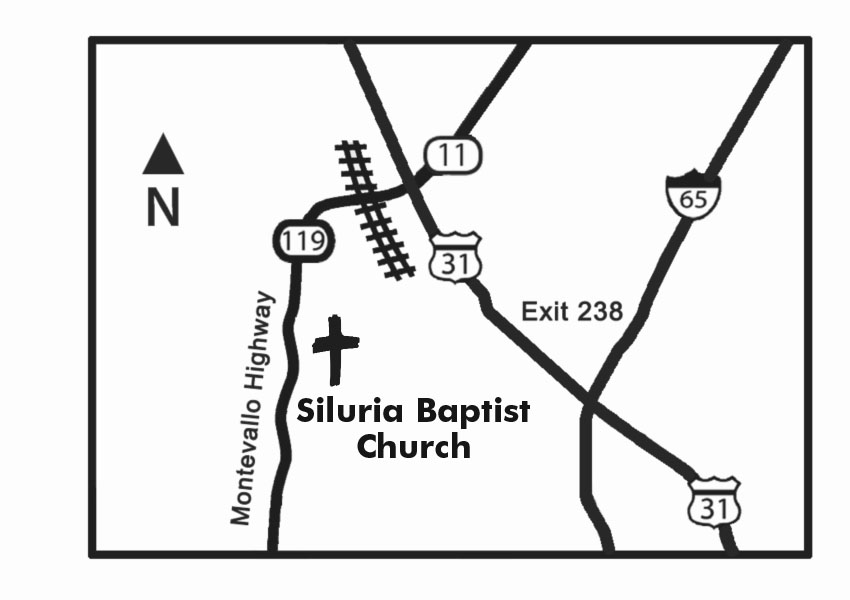
10696 Highway 119 South, Alabaster, Alabama 35007
205.663.7904
Facebook.com / SiluriaBaptistChurch
and / SiluriaBaptistFamily
E-mail / siluriabaptist@gmail.com